2010年2月9日火曜日

Happy New Years!

Ok... so I have been pretty lazy with the updates.. I'm thinking lack of motivation.

I have been keeping far too busy that I would like to be but have been doing cool new things in security here as well as outside of work and still learning alot everyday... I have many different things I would like to write about if I get the time....
So if you are interested, then post a comment or email me at kobe.ninja (a t) gmail and yell at me to start writing more!

So although it is already February (time flies by fast!), I wish everyone a happy year of the Tiger!

2009年12月11日金曜日

Subverting Fingerprint Scanners


So you probably heard about this already as it has been mentioned on BBC News, Slashdot and one of my favorite new sources, HiTB.

From BBC News:

"Lin Rong, 27, had previously been deported from Japan for overstaying her visa. She was only discovered when she was arrested on separate charges.

Tokyo police said she had paid $15,000 (£9,000) to have the surgery in China.

It is Japan's first case of alleged biometric fraud, but police believe the practice may be widespread.

Japanese police suspect Chinese brokers of taking huge sums to modify fingerprints surgically.

Local media reports said Ms Lin had undergone surgery to swap the fingerprints from her right and left hands.

Japanese newspapers said police had noticed that Ms Lin's fingers had unnatural scars when she was arrested last month for allegedly faking a marriage to a Japanese man."


From about 3 years ago, Japan has required all foreigners to have their fingerprints scanned and picture taken at customs when entering the country. This has cost an ENORMOUS amount of money to deploy and has been seen as a complete waste and useless at best by most security experts here. The system was installed in the name of "preventing terrorism" (the popular excuse for anything these days) but many think it is just an excuse to be able to crack down even more on illegal foreigners, despite the already hard time it is to get into (and be able to stay legally in) this country. The system was based off the the U.S. list of known terrorists which is known to be highly inaccurate. Just ask Bruce Schneier.

Actually, this is not really new news at all as I heard about this on NHK (I believe) several months (maybe year?) back. They were reporting on not Chinese, but how in South Korea there is a big semi-underground market to supply people with a clear plastic film to put over your fingers that will fool the fingerprint scanner. This has been going on since shortly have the installment of the system apparently. The thing that I thought was most interesting about this was that they said either the cost of the fake plastic fingerprint or the cost that people were paying for them was less than a dollar. One would naturally think it is the manufacturing cost of the actual plastic that is less than a dollar but I am pretty sure I remember they said that people were buying these things for that price! (Although I wouldn't take my word for it as my memory isn't so great in my old age..) But if my memory serves me correct, it means that this Chinese woman isn't a very a wise spender as she could have easily saved money buying a plane ticket to South Korea ($300?), picked up some of those plastic fake fingerprints for a couple bucks and saved $14,700 along with permanent scars. ^^v

2009年12月2日水曜日

Be careful when illegally exporting to North Korea

Two men, one 62 and one 73 were arrested in my (figuratively speaking) backyard, the Kobe port, for trying to export clothes and other luxurious goods to North Korea. (About $60,000USD worth of goods)
It is the first time for someone to get arrested for illegal exports to the country since increased sanctions introduced last year because of the long range missile tests of Japan and continued nuclear weapon productions.


Source

2009年12月1日火曜日

First Mass? Arrests In Copyright Infringement Bust


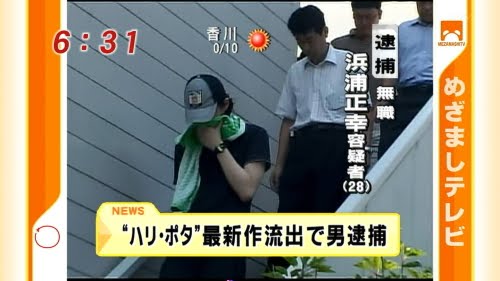
(Headline: Man arrested for leaking new Harry Potter)


Yesterday, the National Police Agency announced that they arrested 11 people in 10 different provinces around Japan for copyright infringement. This is the very first time that authorities have cooperated together and performed a "large scale" (I use the term relatively) bust on many people at once.
Currently, only uploading copyrighted materials is illegal but as of next January (28 days left!) downloading copyrighted material will also become illegal thanks to a revision in the copyright laws.

The police say they will started cracking down hard as of next year...

The person that was shown on the news I saw yesterday about this and is written in the article is a 47 year old man from Nagano who would upload hit songs. In October alone this year, he uploaded to around 9600 people, supposedly causing "damages" of around 77,000,000 yen (around $770,000USD)

By the way, the P2P software that all of these people were using is called "Share", the sort of replacement for Winny. Share is a closed source program that it only available on Freenet. The author of the program keeps anonymous as he/she does not want to end up with the same fate as the Winny creator. (and with good reason!)
The main benefit of the program was that it was supposed to guarantee anonymity, which it obviously fails to do....

Here are some other cases where people have been arrested for using this software(from wikipedia):
Three Japanese people aged 21 to 41 were arrested in Kyoto, Japan on 9 May 2008 for illegally uploading anime files with Share. These were the first Share-related cases in Japan. Nevertheless, a research showed that there was no significant drop of on-line Share users after these arrests.

On 27 November 2008, another male Share user was arrested in Japan for illegally uploading Japanese TV drama with Share.

On 12 February 2009, the first two male Share users were caught for uploading Child pornography with Share.

On 30 September 2009, multiple Japanese media reported that two men were arrested for uploading Nintendo DS game software which include Square Enix's Dragon Quest IX. They are the first users arrested for uploading DS games.


Since 2001, there has only been 26 cases of people being arrested for copyright infringement for distributing over P2P networks. 6 of them have been in 2009.


As the Japanese culture makes people be very crazy about sticking to the rules no matter how silly, small, etc... they could be, I wouldn't be surprised if there was a much larger rise in people getting arrested (and no doubtfully getting fired from their jobs short after, being put on national news shown as a criminal..as if someone among the ranks of a terrorist, and probably causing many other major reasons for severe depression) just for providing a few songs or games over P2P networks, something that would probably be overlooked in the rest of the world.

(I only post this picture of Ed Norton from American History X as I thought it was weird that it came up on a google image search when I searched for "Share Arrests"(in Japanese). Nonetheless, this is probably the image that the general public has on file sharers thanks to the way the media portrays them)


For the last image of the day, I post this as I thought it was cute and particularly Japanese. Every time someone gets arrested for a computer crime like this the police lay out all of the seized computer equipment nice and neat on a table and that gets shown on the news as they talk about the incident.


Source: Yahoo Japan News

Cracking Down on Net Cafes

A couple days ago, there was an announcement about considering "hardening" net cafes in the Tokyo metropolitan area that would require by law net cafes to ID all customers and keep that information for up to 3 years. This is to prevent abuse at net cafes which are seen by some as a "breading ground for evil" since anyone can use the computers.

At the earliest, this ordinance will be brought up in the Diet next spring and may be in effect as soon as next year.

As of August, there were 561 net cafes in Tokyo and only 38% did ID checking(/recording?).


Source: Asashi News

2009年11月20日金曜日

"Runaway Sites"

Taken from the Japantimes.

News photo
Desperate measures: A cell phone in Shibuya, Tokyo, shows an "iede saito" (runaway site), where runaway girls post requests for a place to stay in return for sex. YOSHIAKI MIURA PHOTO

'Runaway sites' latest Net-based exploitation of young girls

Men provide a place to stay for troubled youths in return for sex


Staff writer

First there were the "enjo kosai" Internet sites where underage girls hook up with adult males in exchange for money. Now there's a new type of Web site that unites girls running away from home with men offering a place to stay in return for sexual favors.

Called "iede saito," or runaway sites, and potentially harmful to children, they provide a forum where messages posted by runaway girls asking for a place to stay are answered by men.

Observers say such sites have emerged because the operators and male users want to dodge new laws on "deaikei," or "encounter sites" (where members of the opposite sex can meet), that ban people under 18 from using them, diminishing the chance they will attract underage girls.

"If you regulate one type of Web site, users will go to another," said Atsufumi Suzuki, an expert on Internet activity. Runaway sites first emerged about five years ago, he said.

With online encounter sites flourishing as a hotbed for sex with minor girls seeking pocket money, a law was introduced in 2003 that bans under-18 users and, since last year, requires site operators to register with authorities and confirm the identity of their users.

Another law regulating Internet use by minors was passed in June, this one requiring that cell phones used by children under the age of 18 block sexually provocative sites, although their parents can switch this feature off.

These regulations do not apply to runaway sites, which technically carry messages only seeking accommodations.

One message posted on an online bulletin board for runaways last month stated: "I am a high school student in Osaka. I've been living in an Internet cafe, but I don't have any money left. I am prepared to do anything."

A response reads, "I live in Kyoto but I can come pick you up."

The runaways refer to the men as "kami" (god) and themselves as "kamimachi" (god-waiting).

A 17-year-old girl named Eri in Kita Ward, Tokyo, told The Japan Times she used a bulletin board to find the man who put her up and fed her for five days during the summer holiday in August.

The girl, who withheld her surname, said she fled home because her older brother was causing trouble and her father was violent. She stayed with the man in Saitama Prefecture for five days and slept with him during that time. She believes he was in his 30s.

"I just wanted to get away from it all, they were being so annoying," she said.

While many of the runaway girls are not seriously harmed by their hosts, in some cases it can lead to sexual violence or confinement, said Tetsuya Shibui, a freelance journalist who wrote "A True Account: Underground Web Sites Crime Report" ("Jitsuroku: Yami Saito Jikenbo").

Last year, 724 people under 18 were victims of real-world crimes such as rape in connection with encounter sites, while 792 youths were victims of crimes that stemmed from other types of sites, including runaway sites, game sites, profile sites and social networking sites, according to the National Police Agency, which released such figures for the first time this February.

There is no official figure for the number of runaway sites, but experts estimate there are currently about five runaway bulletin boards, while many posts with this kind of content are also found on nondedicated bulletin boards.

There are also around 50 sites run by encounter site operators, some of whom act as agents for prostitution organizations that dispatch call girls pretending to be runaways, according to Shibui.

The runaway sites attract girls from unhappy households who are prepared to offer sex to strangers for protection and sometimes money, Shibui said.

"Until recently, runaways were 'yankees,' slightly bad girls, who already had such networks, but now good girls also flee home and they don't have these networks," he said.

The sites also provide a solution for girls who want money but cannot find work in the entertainment industry due to strict age restrictions, he said.

The police are urging the operators of runaway sites to self-regulate, according to the NPA, but such clampdowns are ineffective because operators will simply start up new types of sites, according to the Internet expert Suzuki.

"It is hard to find a simple answer since it involves family problems and sex-related issues, which is why there is a tendency to blame it on the Internet, but that is only a haphazard solution," he said.

Experts say the emergence of the runaway sites is a reflection of the behavior of minor girls nowadays, who tend to be less resistant to sex and see it as a bargaining tool to secure protection.

According to a 2005 survey by the Japanese Association for Sex Education, about 30 percent of girls between the ages of 15 and 17 attending high school said they have had sex, 6 points more than in the previous survey in 1999. The report sampled 1,093 high school girls nationwide.

Offering minors a place to stay and having sex with them is illegal under various laws. Sexual activity with anyone under 13 is a crime, while it is also illegal to have sexual relations with someone under 18 if money is exchanged.

It is also forbidden in many prefectures for minors to stay out overnight without parental permission.

Since 2006, at least six men have been arrested for engaging in sexual activity with girls they met over runaway sites. Company employee Keiichi Koma, 31, was arrested last month by Tokyo police on suspicion of performing obscene acts on a 13-year-old girl.

But in other cases, it is difficult to clarify the nature of the relationship, as some men do not demand sexual favors or pay, and a runaway might be given a job that technically makes her an employee, Shibui said.

The men offering accommodations tend to be in their 30s, but they are not necessarily single, and some genuinely want to help runaways, according to Shibui.

"One might be lonely during the few days his wife is on a business trip, and it's a choice between a runaway girl or 'delivery health' (call girl service). Then there are some who fled home themselves as kids, and they are genuinely worried about the girls and do not necessarily demand sexual favors."

Observers say runaways use the sites instead of turning to friends or relatives because they fear being discovered. Some stay with the same man while others flit from one to the next, sometimes by recommendation from fellow runaways or by being passed around between men who make the arrangements online.

In some cases the girl has no intention of returning home and the parents don't press the matter.

One such runaway that Shibui met was a 15-year-old from Kanagawa Prefecture whose parents had divorced because of domestic violence. The girl, whose name he withheld for privacy reasons, had left home with her mother but preferred her father, and fled home a year ago to live near him.

She still attends school and her parents are aware she is living with strangers, he said.

"The parents think, 'at least if she's in school she's alive.' If they tried to force her home there would be trouble and then she might not even go to school."

Shibui added that not all parents apply for missing person searches — because they would have to inform the police of their domestic troubles.

According to the NPA, applications for missing person searches were submitted for nearly 20,000 runaways aged between 10 and 19 last year.